Last year was a record year for ETFs, with flows once again surpassing historic peaks. Growth does not only concern U.S. equity markets but is increasingly involving bonds, emerging markets and multi-asset solutions as well. ETFs are now the reference instrument for a growing portion of retail investors.
But not everything that glitters is gold.
While it is true that ETFs are taking an ever larger share of the market and that more and more investors prefer them to often more expensive and ineffective instruments, it is also true that the industry is rapidly adapting to this new demand. In particular, many issuers are trying to recover margins through more complex products with higher costs. 2026 could be the year in which, even in Europe, we will begin to see the effects of these changes more clearly.
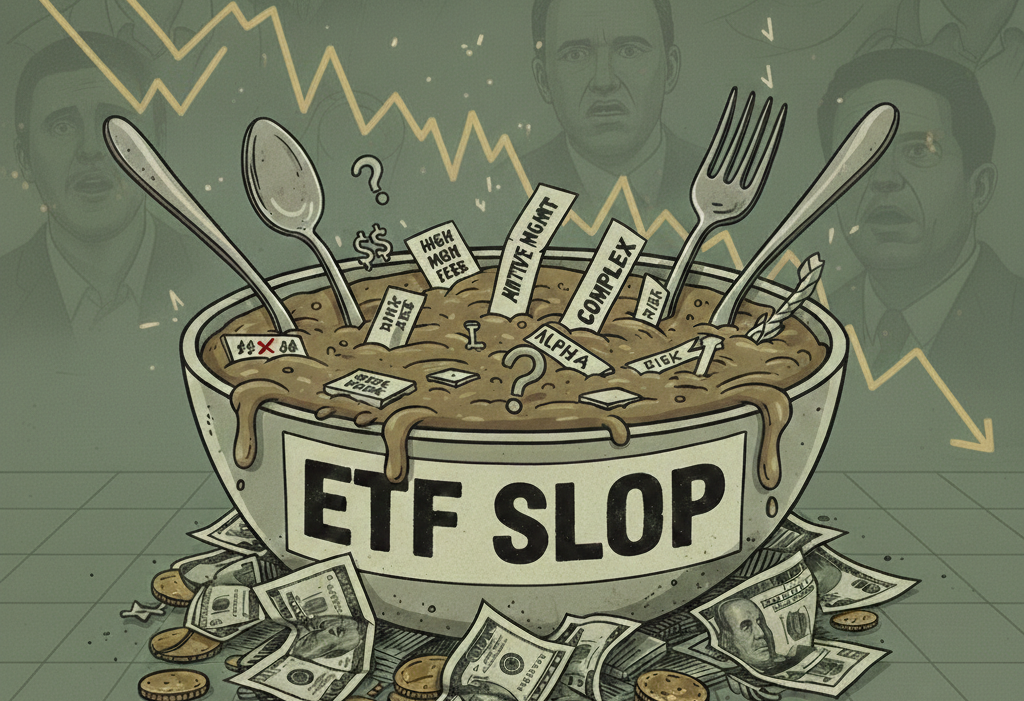
What is ETF slop?
I first encountered this term in one of the most recent videos by Ben Felix, who uses it to describe an increasingly visible drift in the ETF industry.
The term “slop” (literally “mush” or “scraps”) was borrowed from the digital world, where it refers to low-quality content produced in bulk, often through artificial intelligence, which ends up clogging the web.
Applied to finance, ETF slop refers to the proliferation of new actively managed and structurally complex ETFs, designed more to capture fees and attention than to offer a real advantage to the investor in the long term.
For years ETFs were the symbol of the “good investment”: passive, transparent, diversified and with very low costs. In recent years, however, the industry has been launching more and more products that seem to depart from this philosophy. Last year, for example, more than 1,000 ETFs were launched in the United States, of which 84% were actively managed. Costs are also rising: the average cost of a new ETF launched in the U.S. is 0.7%. A competitive figure compared to many traditional funds often offered as alternatives, but one that signals a far from positive trend when compared with the original spirit of ETFs.
The distinctive characteristics of “slop”
Obviously not all newly launched products are garbage. Innovation exists and in some cases it can make sense. In his video, however, Ben Felix identifies three recurring characteristics that tend to distinguish ETF slop:
- High costs: as already mentioned, these products tend to have above-average maintenance costs, often reaching or exceeding 1%. Costs of this kind require consistent excess returns to be justified, which in most cases does not occur.
- Complexity: many of these ETFs use derivatives, leverage or options-based strategies. This makes it difficult for the average investor to understand what they are actually buying, what the real risks are and how the product may behave in adverse market scenarios.
- Marketing based on bias: the commercial success of these ETFs is often linked more to narrative than to fundamentals. Enthusiasm for new trends, the search for “easy” income or fear of losses are exploited, leveraging well-known biases in behavioral finance.
The expansion in Europe and the role of ETF-as-a-service
This trend is not limited to the United States. In Europe as well, similar signals are beginning to appear, albeit with some delay. The rise of products of this kind could be supported by new infrastructures such as “ETF-as-a-service.”
There are already companies in the European sector that are launching products to easily launch new ETFs even for private banks, asset managers and digital platforms that until a few years ago would not have had the resources to do so. The declared objective is to democratize access to the ETF vehicle, but the side effect could be a significant increase in products born more for commercial needs than to solve real investment problems.
Services like these drastically reduce barriers to entry by lowering:
- Approval times: from 12–24 months to 3–5
- Costs: from about 1 million dollars to amounts between 50,000 and 150,000 dollars
In such a context it becomes much easier to test new product ideas, but also to saturate the market with niche ETFs destined to survive only as long as they manage to attract flows.
Conclusions
In summary, ETF slop is the result of an industry that is trying to recover profit margins lost with the revolution of low-cost passive products. The ETF vehicle remains extremely efficient, but it is no longer a guarantee of quality in itself.
For those approaching investing today, navigating a sea of products could become increasingly complex: quality still exists, but it is increasingly buried under a mountain of products engineered for sale rather than for returns.